Judgment search, drafting assistance, MACT calculators, and NI Act tools — trained on Supreme Court & Madhya Pradesh High Court judgments. For district-court practitioners and judicial officers, not metros.
One platform, three workflows — calibrated to how judges adjudicate, how advocates litigate, and how students learn.
Real screens from the running application — dashboards calibrated to each role, calculators wired to Supreme Court precedent, and an AI research assistant grounded in 22,000+ NI Act cases.
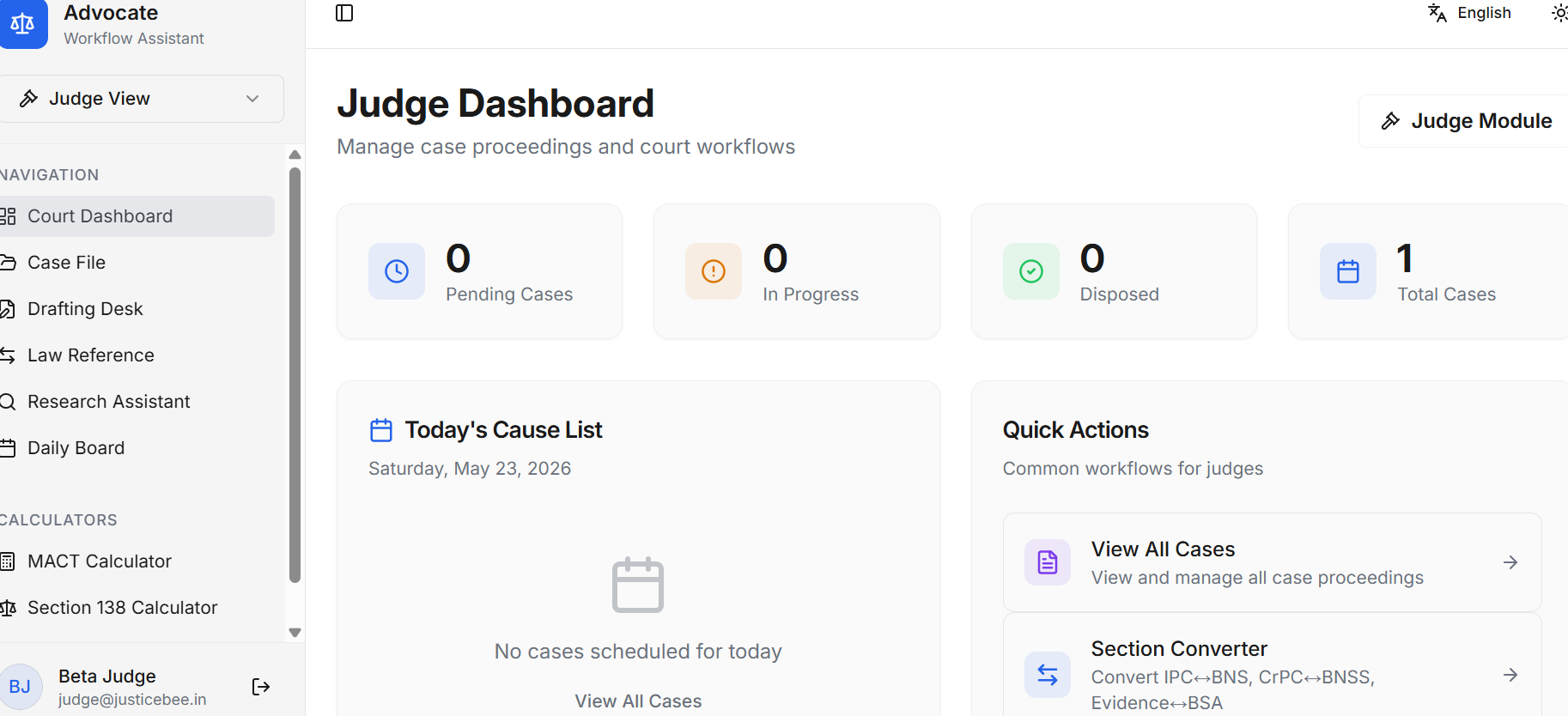
Pending, in-progress and disposed cases at a glance, with today's cause list and quick-jump to all open matters.
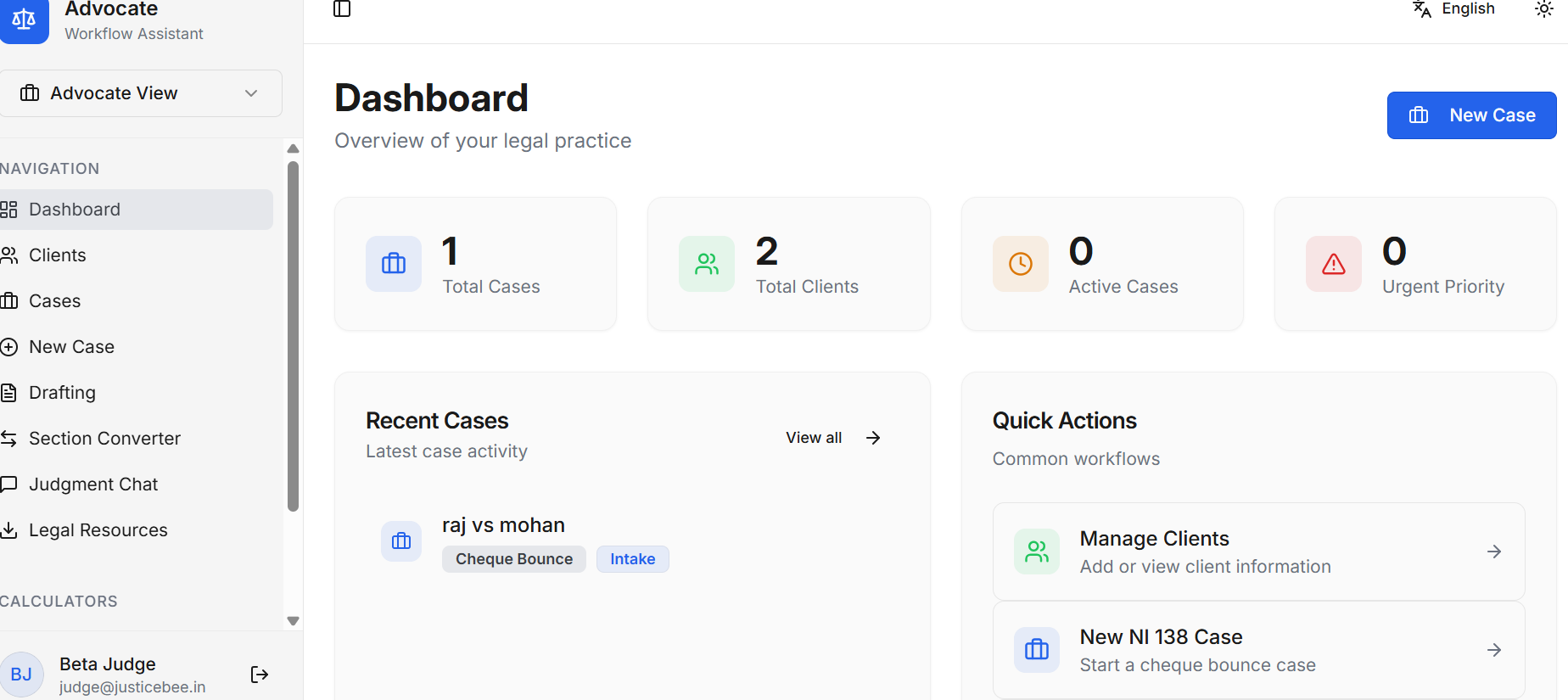
Total cases, active clients, urgent priorities, and recent matters — with one-tap intake for new §138 / MACT files.
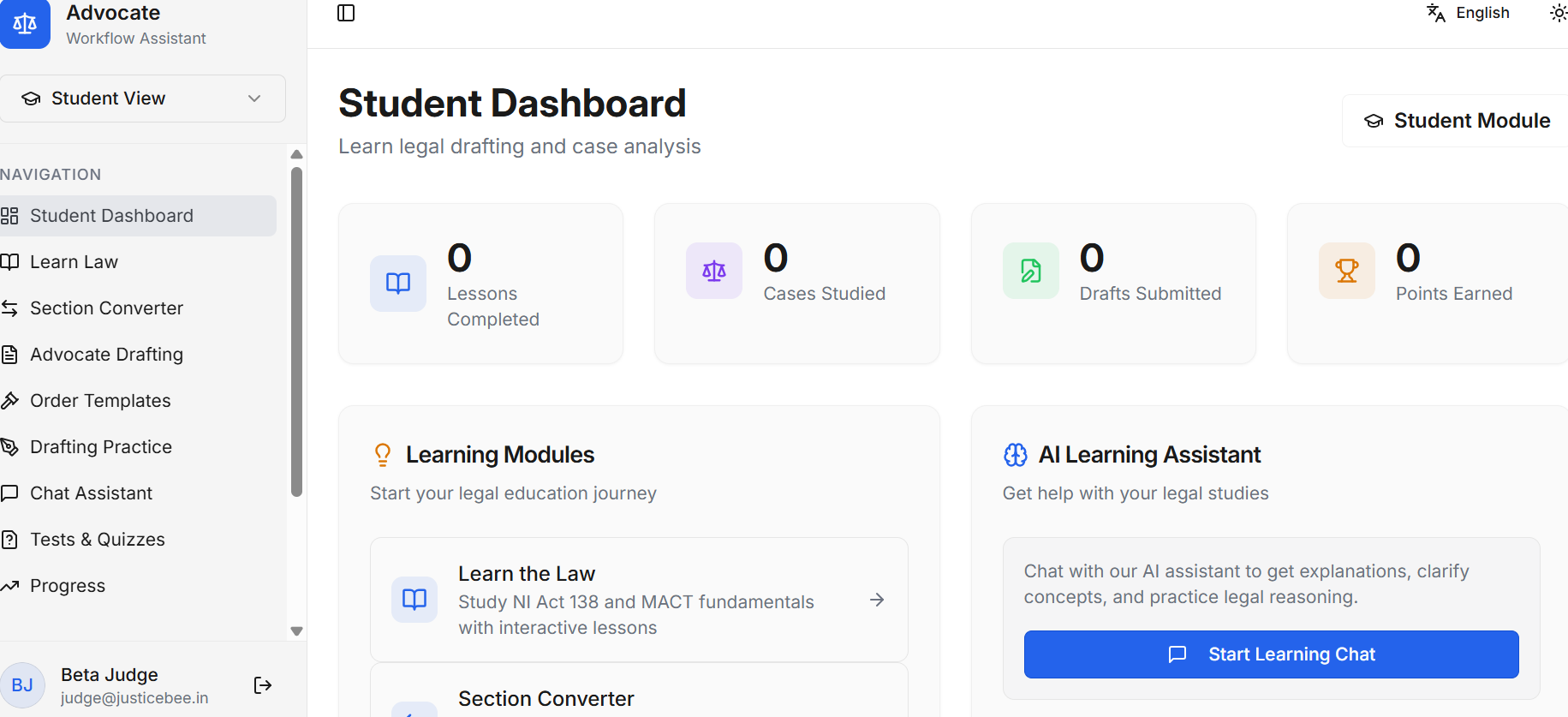
Lessons on NI 138 and MACT fundamentals, drafting practice with AI feedback, and an always-on study chat.
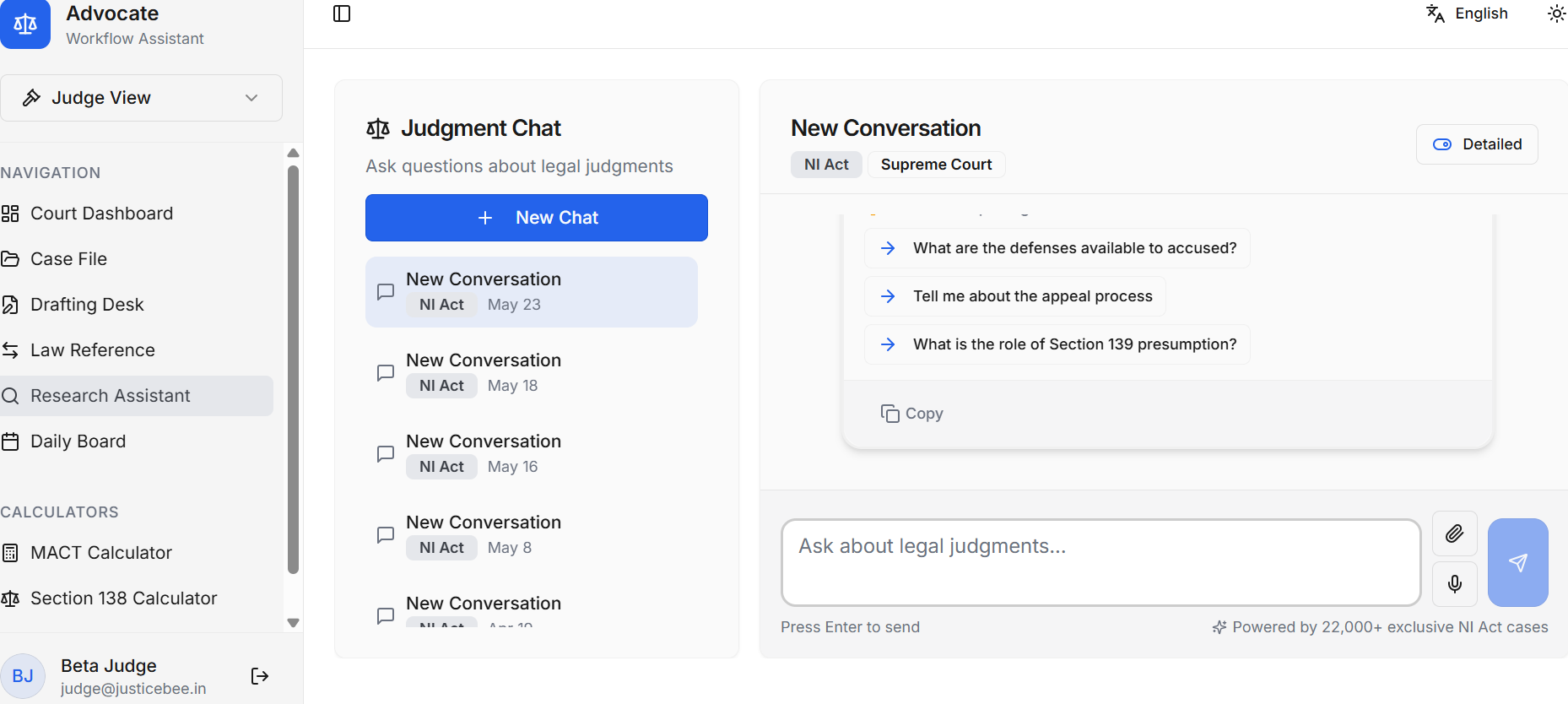
Detailed or summary mode. Conversations persist, suggested follow-ups appear inline, and every response is grounded in 22,000+ exclusive NI Act judgments — no fabrication.
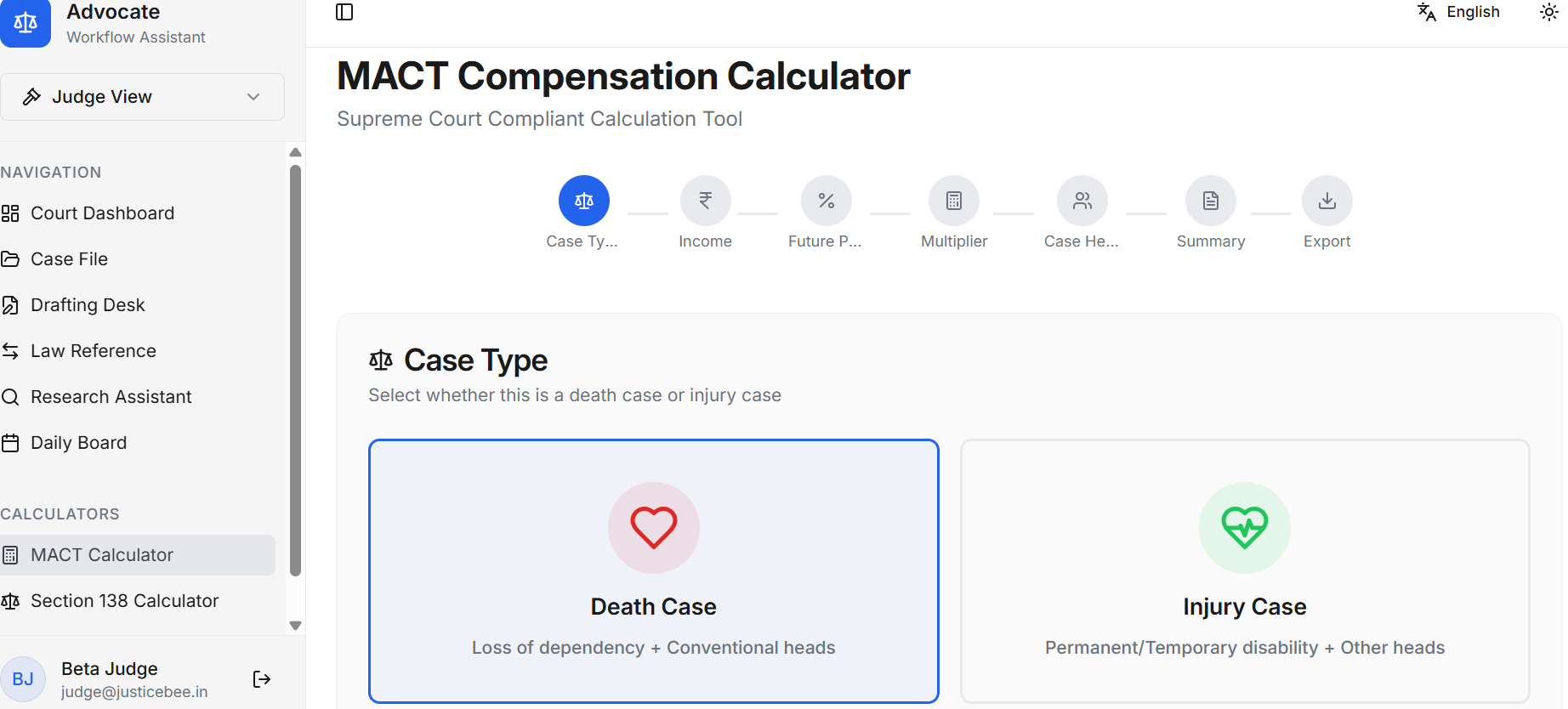
Seven-step wizard: case type → income → future prospects → multiplier → heads → summary → export.
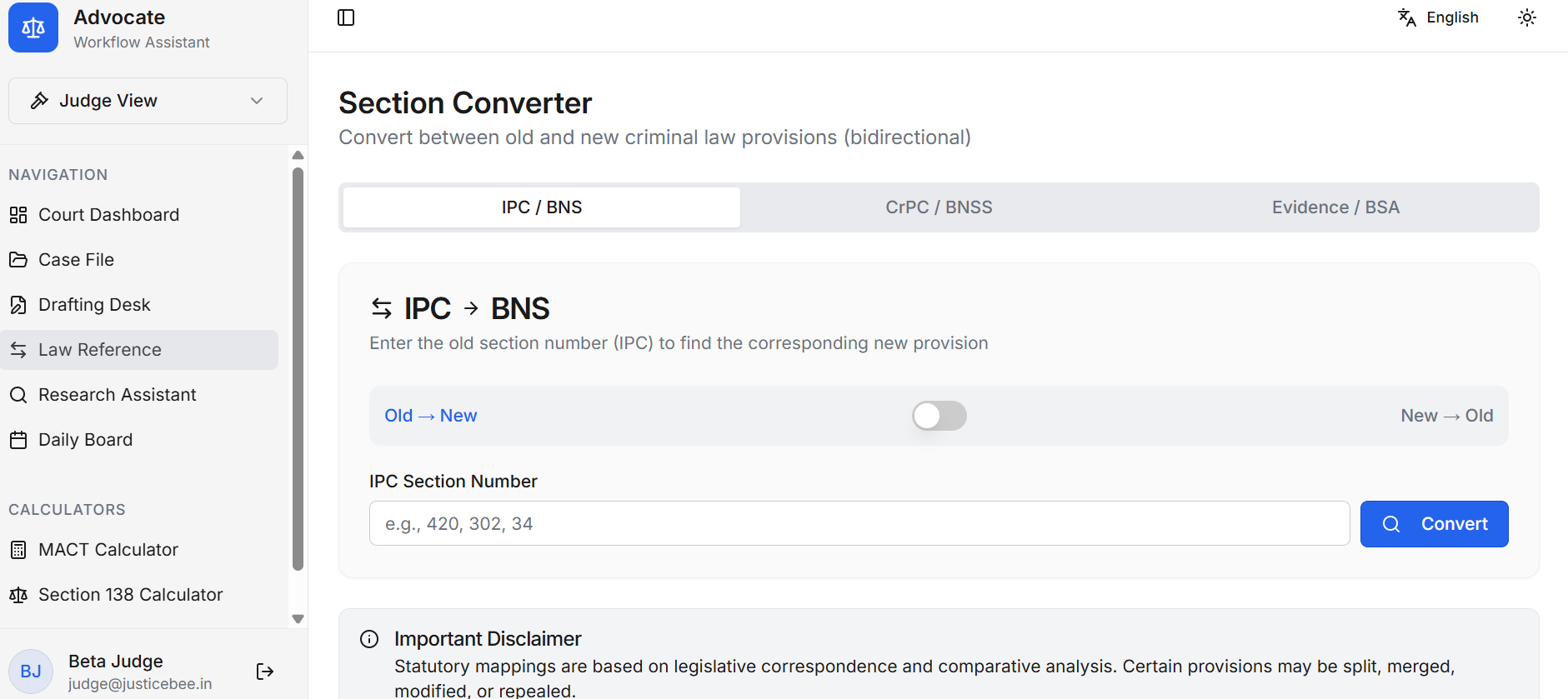
Bidirectional mapping across IPC ↔ BNS, CrPC ↔ BNSS, and Evidence Act ↔ BSA. Toggle direction, enter a section number, get the corresponding provision with diff notes.
Every dashboard, calculator, and template view in mylawrd.ai supports English & हिन्दी, light & dark theme, and switches between Judge / Advocate / Student context without leaving the workspace.

Every feature is grounded in the judgment corpus. Nothing is invented. When MY LAWRD can't cite a source, it says so.
Stop calculating compensation by hand. Court-ready numbers, every input visible, every multiplier traceable to its judgment.
Compute Loss of Dependency, Future Prospects, and Conventional Heads with personal-expense deductions — in line with Sarla Verma v. DTC (2009) and National Insurance v. Pranay Sethi (2017). Every input is visible; every multiplier links back to its judgment paragraph.
Try Calculator →Calculate filing court fee for cheque-bounce complaints across 22 Indian states. Madhya Pradesh uses progressive slabs (first ₹1L: 5%, next ₹4L: 4%, above ₹5L: 3%, max ₹1,50,000). Most other states levy a fixed ₹150–250.
Try Calculator →| State | Cheque amount | Court fee |
|---|---|---|
| Madhya Pradesh | ₹ 5,00,000 | ₹ 21,000 |
| Maharashtra | ₹ 5,00,000 | ₹ 200 |
| Delhi | ₹ 5,00,000 | ₹ 250 |
| Karnataka | ₹ 5,00,000 | ₹ 150 |
| Tamil Nadu | ₹ 5,00,000 | ₹ 200 |
| Uttar Pradesh | ₹ 5,00,000 | ₹ 150 |
Appeals against conviction under §138 require a mandatory deposit of at least 20% of the fine or compensation awarded. Instantly compute the minimum deposit and the full cost of appeal — deposit, court fee, and process fee, itemised.
Try Calculator →Every case type has a predefined workflow with checklists and document requirements at each stage. Know where every file stands.
Every answer is traceable to a paragraph in a real judgment. If the corpus doesn't have it, MY LAWRD doesn't invent it.
Enter your legal query in English or Hindi, or upload a document — a plaint, FIR, or prior judgment — for context.
The system pulls the most relevant paragraphs from 24,000+ indexed SC & MP HC judgments — not the whole internet.
The AI composes a structured, citation-backed answer — or drafts a document — using only the retrieved context.
Answers pulled from real judgments in our curated corpus — never free-form guesswork by the language model.
MY LAWRD cannot invent a case name or paragraph. If the corpus lacks a match, it says so — by design, not by prompt.
Built for trial courts, not metros. MP High Court corpus, BNSS workflows, and statutes as they're used daily.
Not a wrapper around a search box. MACT math, cheque-bounce flows, IPC↔BNS diffs — the actual work.
“As someone who has spent years on the bench, I know how much time district court judges spend on drafting alone. mylawrd.ai addresses that problem directly — correct procedure, correct citations, bilingual output. India's district courts needed exactly this kind of assistance. What makes this particularly noteworthy is that this platform has been built by a young woman from Madhya Pradesh — that in itself is commendable. I wish the team, especially Honey Pali, the very best in this endeavour. I hope mylawrd.ai reaches every district court in the country.”
“I have been using mylawrd.ai for some time now. The judgment search tool is genuinely useful — finding relevant Supreme Court and High Court decisions without going through multiple databases saves real time. The section converter between IPC and BNS is accurate and practical for day-to-day work. The calculators for MACT and NI Act matters are straightforward. The drafting assistance is a reasonable starting point, though the judicial officer must review the output before use. Overall, a tool worth trying for district court work.”
“First of its kind, and exactly what we need. The search results in this platform are precise and spot on — you get what you are actually looking for. If the future upgrades remain as user-friendly as the direction it is heading, this will only get better with time. Ultimately, if it helps reduce pendency — both the Bar and the Bench stand to benefit.”
“The MACT calculator applies Sarla Verma and Pranay Sethi correctly and shows its working. I use it to verify my computation before signing orders. Exactly what a judicial tool should do.”
“What works for me is the search. No lengthy prompts, no guessing what the system wants. I searched for Section 138 dishonour on account closed — it returned relevant HC and SC positions directly from its database. No hallucinations, no made-up citations. For court work, that reliability matters more than anything else.”
“I find the right judgment before a hearing in minutes, not hours. The search understands legal context — it doesn’t just match words. Practical tool for district court practice.”
“I was skeptical about AI for legal work. MY LAWRD changed that — it’s built for Indian courts, not adapted from something foreign. The MACT and NI Act coverage is solid.”
India's criminal law has been completely recodified. The Section Converter keeps you current — bidirectionally, with diff-style notes on what changed.
Bare acts and landmark judgments — indexed, searchable, and downloadable. Six core acts ship in the base library.
NI Act, MACT, and the new BNS / BNSS / BSA framework — not a foreign system translated into Indian context.
Calculators follow Sarla Verma and Pranay Sethi. Every output is traceable to the paragraph it comes from.
Case data stays in your workspace. No cross-tenant training. No sharing with third parties — by architecture, not by promise.
About
MY LAWRD exists because generic AI fails Indian courts. Our corpus is the district judge's bench, the trial advocate's desk — not Silicon Valley's imagination.
mylawrd.ai is built by a lawyer who understands Indian courts from the ground up. Honey Pali's legal training at two of Madhya Pradesh's premier law institutions — Dr. Hari Singh Gour University and NLIU Bhopal — shaped a product designed specifically for how district courts actually work, not how metros assume they do. Our mission is to make high-quality AI-powered legal research accessible to every judicial officer and advocate in India, starting with Madhya Pradesh.
Indore , Madhya Pradesh · India
Schedule a demo. We'll walk through your workflow and show where MY LAWRD fits.
Request a Demo →How would you like to continue?